Nm vs Ft-Lbs: What's the Difference and When to Use Each
Table of Contents
This guide compares the two units and when to use each. If you are new to torque, start with the beginner’s guide to Nm and ft-lbs; to run the numbers yourself, see how to convert Nm to ft-lbs by hand.
Quick Answer. Nm vs Ft-Lbs at a Glance
If you’re in a hurry, here’s the short version:
- Nm (Newton-meters) is the metric (SI) unit of torque. Used in Europe, Asia, and globally in engineering.
- Ft-lbs (foot-pounds) is the imperial unit of torque. Dominant in the USA and legacy tooling worldwide.
- They measure the exact same thing, rotational force, just in different unit systems.
| Feature | Nm | Ft-Lbs |
|---|---|---|
| Full name | Newton-meter | Foot-pound |
| System | Metric (SI) | Imperial (US) |
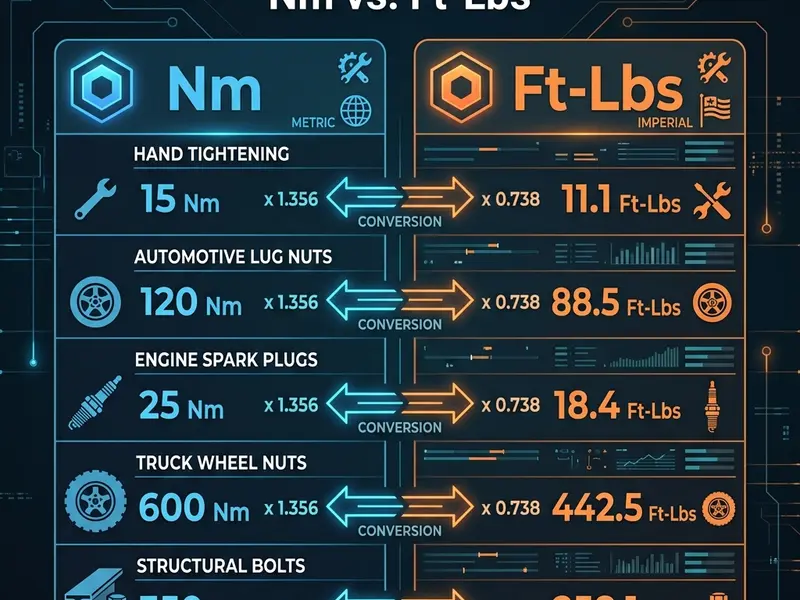
| 1 unit equals | 0.7376 ft-lbs | 1.3558 Nm |
| Used in | Europe, Asia, global | USA, legacy industry |
| Typical on | European/Asian car manuals | American service manuals |
| Precision | High, decimal-based SI | Practical, familiar in US |
Neither is more accurate: they are equivalent measurements expressed in different systems.
Need to convert between them right now? Use our Nm to ft-lbs converter for an instant, precise answer.
What Is Torque? (Why the Unit Matters at All)
Torque Defined in Plain English
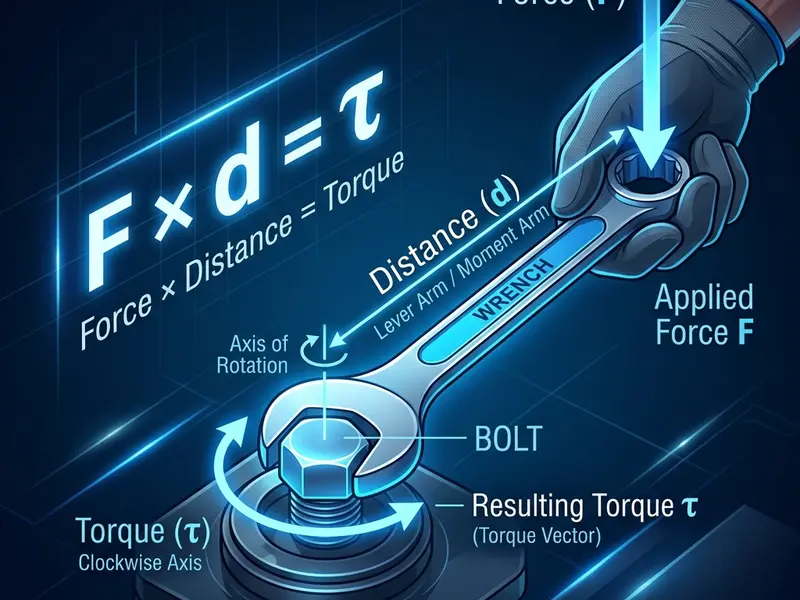
Torque is rotational force, the twisting power you apply when turning a bolt, nut, or any fastener. In physics terms:
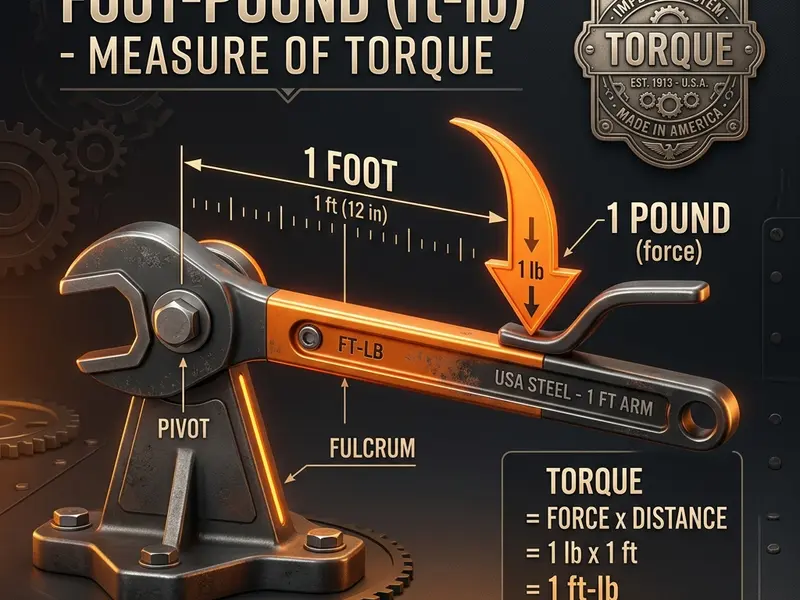
Torque (τ) = Force × Distance from pivot
Here’s the easiest everyday analogy: imagine tightening a bolt with a wrench. The longer the handle, the more torque you generate with the same hand force. That’s because torque is the product of how hard you push and how far your hand is from the bolt.
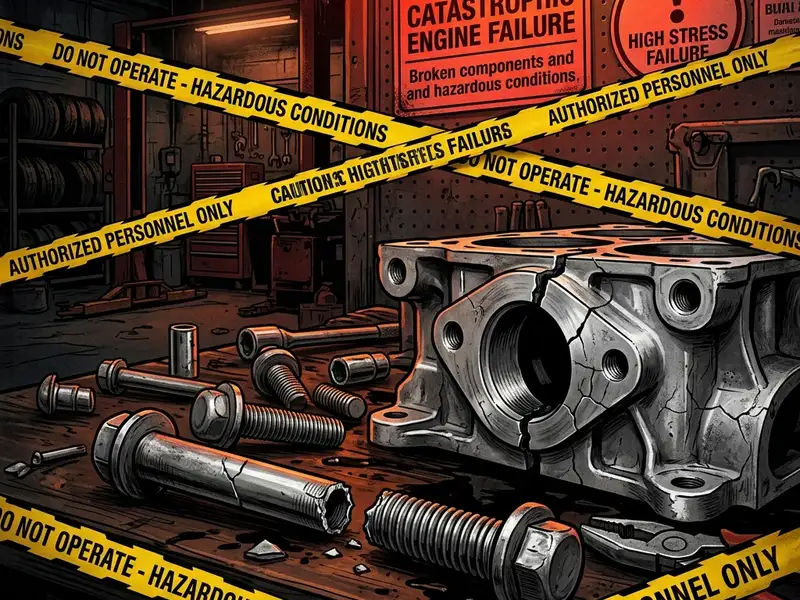
Why does getting this number right matter? Because incorrect torque causes mechanical failures, stripped threads, snapped bolts, cracked castings, or dangerously loose fasteners. Every bolt in your car, motorcycle, or bicycle has a specific torque value for a reason.
Why Are There Two Different Units for the Same Thing?
The world uses two measurement systems: metric (SI) and imperial.
- Most countries adopted the SI system after 1960 → Nm became the global standard for torque
- The United States retained the imperial system → ft-lbs remains dominant in American tooling, manuals, and training
- The result: global supply chains, imported vehicles, and international engineering all require constant conversion between the two
Newton-meter values are easy to work with in calculations and can be converted to other SI units without complex conversion factors, making Nm a versatile unit across many industries. But if you’re in an American garage with American tools, ft-lbs is what you’ll see on the dial.
This dual-system reality is exactly why understanding the difference, and knowing how to convert Nm to ft-lbs by hand, is such a critical skill for anyone who works with fasteners.
What Is Nm (Newton-Meter)? Full Definition
Definition and Origin
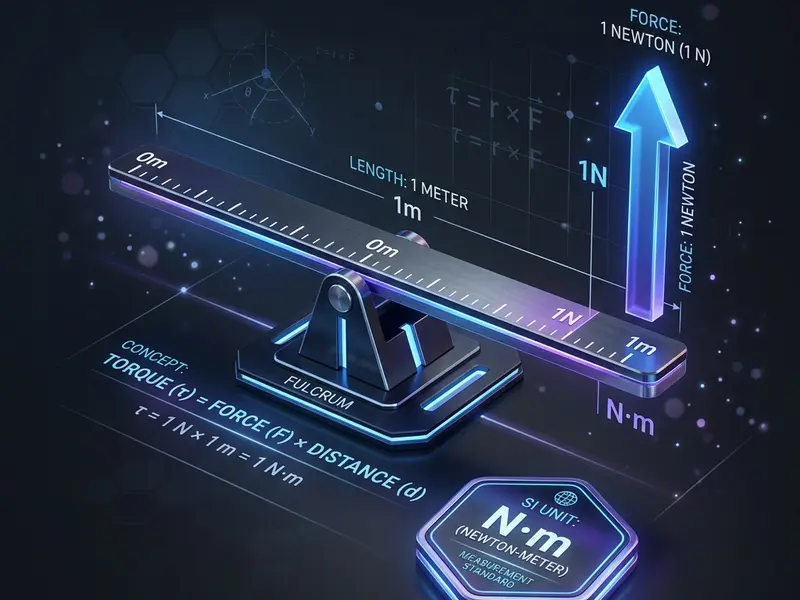
One Newton-meter equals one Newton of force applied at a distance of one meter from the pivot point. It’s part of the International System of Units (SI), the globally standardized measurement framework used in science, engineering, and most countries worldwide.
The unit is named after Sir Isaac Newton, whose laws of motion form the foundation of classical mechanics. Newton-meters and foot-pounds are both units of torque, torque measures the rotational force that causes an object to turn about an axis.
What Does 1 Nm Actually Feel Like?
Think of it as pressing a 100-gram weight at the end of a 1-meter stick. It’s a very light amount of rotational force. Here’s how Nm values scale in real-world applications:
- 1–25 Nm → Spark plugs, bicycle bolts, small engine fasteners
- 25–100 Nm → Oil drain plugs, brake caliper pins, lug nuts on compact cars
- 100–500+ Nm → Axle nuts, cylinder head bolts, heavy drivetrain components
Where You’ll See Nm Specified
- European car and motorcycle service manuals (BMW, Mercedes, VW, Audi, Volvo)
- Japanese and Korean vehicle manuals (Toyota, Honda, Hyundai, Kia)
- Modern power tools, torque drivers, and precision instruments globally
- Engineering documentation, ISO standards, and international specifications
For a deeper dive into what Newton-meters mean and how they relate to foot-pounds, check out our beginner’s guide to torque conversion.
What Is Ft-Lbs (Foot-Pound)? Full Definition
Definition and Origin
One foot-pound equals one pound of force applied at a distance of one foot from the pivot point. It’s part of the Imperial / US Customary measurement system.
The foot-pound is an English Engineering unit that is part of the British Gravitational system, based on the foot-pound-second (FPS) framework, using the foot for length, the avoirdupois pound for force, and the second for time.
What Does 1 Ft-Lb Feel Like?
Think of it as pressing one pound of force at the end of a 12-inch ruler. It’s slightly more torque than 1 Nm (about 36% more, in fact). Here’s how ft-lb values scale:
- 5–20 ft-lbs → Small engine components, household fixtures
- 20–100 ft-lbs → Typical automotive fasteners, lug nuts, suspension bolts
- 100–300+ ft-lbs → Heavy truck components, structural fasteners
Where You’ll See Ft-Lbs Specified
- American vehicle service manuals (Ford, GM, Chrysler, RAM)
- US-made torque wrenches and click-type tools
- Construction and structural applications in the USA
- Older industrial machinery and legacy tooling
Ft-Lbs vs Lb-Ft. Is There a Difference?
This is one of the most common questions in torque discussions:
- Technically: lb-ft (pound-foot) is the correct term for torque per SAE Standard J1349. British physicist Arthur Mason Worthington proposed “pound-foot” in his 1900 book Dynamics of Rotation to reduce confusion with foot-pound, which is also a unit of energy.
- In practice: ft-lbs is universally used in workshops, manuals, and on torque wrench markings. In automotive garages, hardware stores, and general industry, “ft-lbs” has become the universally accepted shorthand for torque.
- For this guide: treat them as identical.
⚠️ Important: Ft-lbs ≠ lbf (pound-force). Lbf measures linear force, not rotational torque. Don’t confuse them.
Nm vs Ft-Lbs. The Core Differences Explained
Difference 1. The Number Size
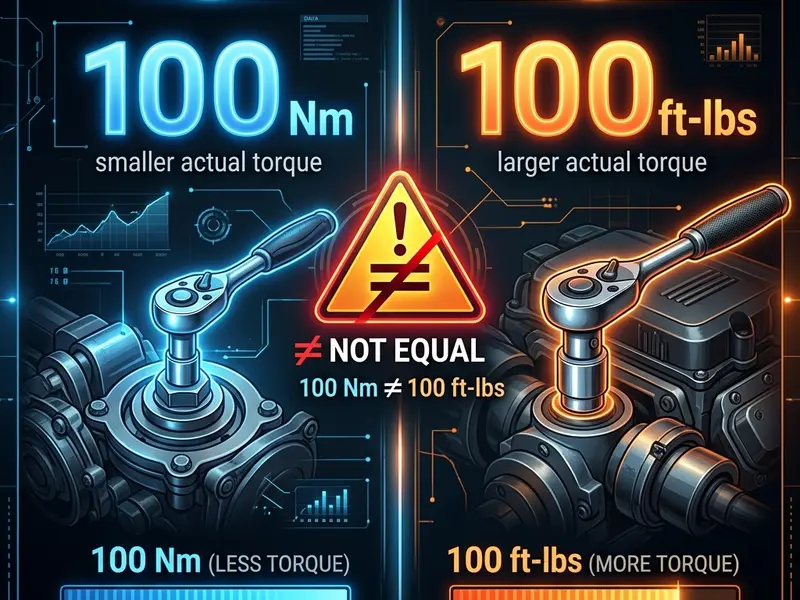
For the same physical torque, the Nm number is always larger than the ft-lbs number:
- 100 Nm = only 73.76 ft-lbs
- 100 ft-lbs = 135.58 Nm
This catches beginners out constantly. 100 Nm ≠ 100 ft-lbs, there’s a 26% gap between them. The practical danger? Setting a wrench to 100 when the spec is in the other unit means you’re either 26% over-torqued or 26% under-torqued. Both can be dangerous.
Difference 2. Precision and Decimal Compatibility
Newton-meters are considered more precise than foot-pounds due to the decimal-based nature of the SI system, making Nm preferred in scientific and engineering applications where precision is crucial.
Ft-lbs involves non-decimal conversions (pounds, feet) making cross-unit math more complex. For everyday DIY work, the precision difference is negligible. But for aerospace, medical devices, and precision engineering, Nm is the industry standard without exception.
Difference 3. Geographic and Industry Convention
| Industry | Dominant Unit | Why |
|---|---|---|
| US Automotive | Ft-lbs | SAE standard, US tooling history |
| European Automotive | Nm | ISO/SI metric standard |
| Japanese Automotive | Nm | Global metric adoption |
| Aerospace (global) | Nm | ISO compliance required |
| Construction (US) | Ft-lbs | ASTM standards, US tooling |
| Construction (Europe) | Nm | Eurocode and EN standards |
| Robotics & Engineering | Nm | SI system universally used |
| Cycling / Precision | Nm | Low values need decimal precision |
Difference 4. Tool Availability
- Most modern torque wrenches display both Nm and ft-lbs on dual scales
- Older or budget tools often show only one unit, critical to know before you start
- Digital torque wrenches can switch units instantly at the press of a button
- Click-type and beam-type wrenches are typically calibrated to one unit only
When to Use Nm. The Right Scenarios
Use Nm When…
- Your service manual is from a European or Asian manufacturer
- You’re working on a modern bicycle, motorcycle, or e-bike (carbon fiber components especially, over-torquing cracks carbon)
- You’re an engineer following ISO, EN, or international standards
- Your torque wrench is a digital model that defaults to metric
- You’re doing precision work requiring fine decimal control
- You’re documenting or certifying work under ISO 9001 or similar frameworks
Industries and Use Cases That Favor Nm
- Aerospace fasteners (FAA/EASA documentation uses Nm)
- Medical device assembly (ISO 13485 compliance)
- EV and battery module assembly (global supply chains)
- Robotics and servo motor specifications
- Wind turbine and solar mounting hardware
💡 Pro Tip: If you’re unsure which unit to use, default to Nm. It’s the global standard and eliminates ambiguity in cross-border or cross-brand work.

When to Use Ft-Lbs. The Right Scenarios
Use Ft-Lbs When…
- Your service manual is for an American-made vehicle
- Your torque wrench only reads in ft-lbs (common with older US-made tools)
- You’re working in a US shop where specs are quoted in ft-lbs
- You’re following ASTM structural bolt standards
- You’re working on US construction or industrial equipment with imperial specs
Industries and Use Cases That Favor Ft-Lbs
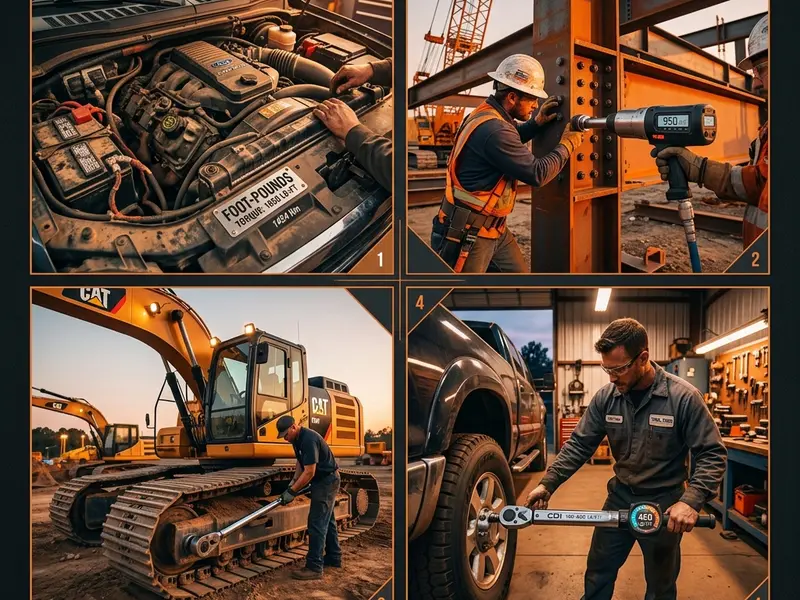
- US automotive, mechanics and car enthusiasts use ft-lbs when working on engines, transmissions, and other mechanical components
- US construction and structural steel work
- American agricultural and heavy equipment
- Legacy industrial machinery manufactured before metric adoption
💡 Tip: Even if you prefer ft-lbs, always verify whether your spec source uses Nm or ft-lbs before tightening. When in doubt, use our Nm to ft-lbs converter to double-check.
Nm vs Ft-Lbs. Which Is “Better”?
The Honest Answer: Neither Is Better
Both measure the exact same physical quantity with equal accuracy. “Better” depends entirely on:
- Your location, are you in the US or abroad?
- Your tools, what does your torque wrench read?
- Your industry, what standard does your work follow?
- Your manual, what unit does the manufacturer specify?
The question isn’t which is better, it’s which matches your context.
The Decision Framework, 3 Questions to Ask
Before you pick up your torque wrench, answer these three questions:
Question 1: What unit does your service manual use? → Use that unit. Always match the spec.
Question 2: What unit does your torque wrench read? → If it doesn’t match the manual → convert Nm to ft-lbs by hand, then set the wrench.
Question 3: Is this safety-critical? → Yes → Use the exact conversion formula (× 0.7376 or × 1.3558) → No → Mental math estimate is fine (× 0.74 or ¾ rule)
The One Rule That Overrides Everything
Always match your wrench setting to the converted value of the specification, never assume the numbers are interchangeable.

How to Convert Between Nm and Ft-Lbs (Quick Reference)
The Formulas
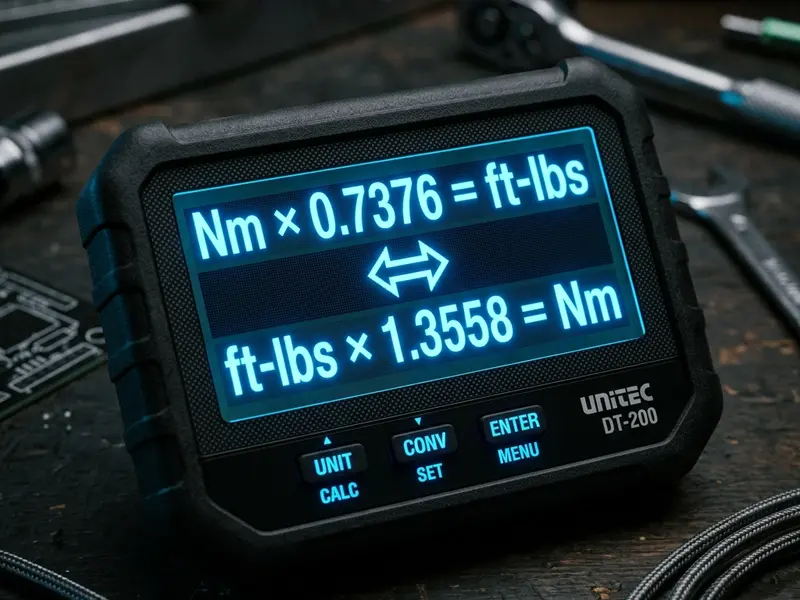
Nm → Ft-lbs: ft-lbs = Nm × 0.7376
Ft-lbs → Nm: Nm = ft-lbs × 1.3558
That’s it. Two numbers to memorize. For a deep dive into the math behind these formulas and step-by-step worked examples, see our guide on how to convert Nm to ft-lbs by hand.
Quick Conversion Table
| Nm | Ft-Lbs | Common Use |
|---|---|---|
| 10 | 7.4 | Small engine bolts, electronics |
| 25 | 18.4 | Spark plugs, oil drain plugs |
| 50 | 36.9 | Brake caliper pins |
| 80 | 59.0 | Lug nuts (small cars) |
| 100 | 73.8 | Lug nuts (mid-size cars) |
| 120 | 88.5 | Wheel bolts (larger vehicles) |
| 150 | 110.6 | Suspension components |
| 200 | 147.5 | Axle / hub nuts |
| 300 | 221.3 | Heavy drivetrain bolts |
Need values between these? Our printable Nm to ft-lbs torque chart covers every whole number from 1 to 1000, grouped by application.
Mental Math Shortcut
Multiply Nm by ¾ (or × 0.74) for a fast workshop estimate:
- 80 Nm → 80 × 0.75 = 60 ft-lbs (exact: 59.0) ✓
- 100 Nm → 100 × 0.74 = 74 ft-lbs (exact: 73.8) ✓
Accurate within ~2%, perfectly fine for non-safety-critical work.
Common Mistakes When Comparing Nm and Ft-Lbs
Mistake 1. Assuming 1:1 Equivalence
The #1 error: treating 100 Nm as equal to 100 ft-lbs. In reality, 100 Nm is only 73.76 ft-lbs, a 26% gap. Setting 100 ft-lbs when the spec says 100 Nm results in dangerous over-tightening. Always confirm the unit before applying force.
Mistake 2. Confusing Ft-Lbs with In-Lbs
Inch-pounds (in-lbs) are 12× smaller than foot-pounds:
- 1 ft-lb = 12 in-lbs
- If a spec says 60 in-lbs and you set your wrench to 60 ft-lbs, you’ll apply 12 times the intended torque, a guaranteed broken component
This is especially common on small engine or bicycle specs. Always check: does the spec say “ft-lbs” or “in-lbs”?
Mistake 3. Using the Wrong Conversion Direction
Multiplying instead of dividing (or vice versa) flips your result by 78%. Always remember:
- Nm → ft-lbs always produces a smaller number
- Ft-lbs → Nm always produces a larger number
If your conversion result is larger than your starting Nm value, you went the wrong direction.
Mistake 4. Ignoring Thread Condition
Torque specs assume specific thread conditions, dry, lubricated, or with thread-lock. Changing the thread condition changes the effective clamping force even if the unit conversion is perfect:
- A lubricated bolt achieves ~20% more clamping force at the same torque setting
- A dry bolt with corrosion may need more torque to achieve the same clamping force
- Always check the spec note for thread condition assumptions
Nm vs Ft-Lbs in Real-World Applications
Automotive. European vs American Vehicles
| Vehicle Origin | Manual Uses | Your Wrench Reads | Action Needed? |
|---|---|---|---|
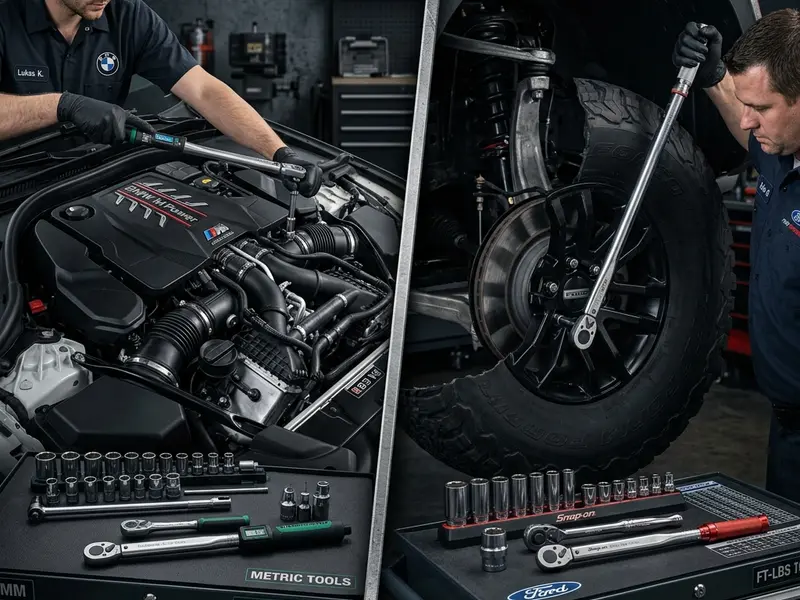
| German (BMW, VW) | Nm | Ft-lbs | Convert before setting |
| Japanese (Toyota, Honda) | Nm | Ft-lbs | Convert before setting |
| American (Ford, GM) | Ft-lbs | Ft-lbs | No conversion needed |
| American (Ford, GM) | Ft-lbs | Nm | Convert before setting |
Motorcycles and Bicycles
- Japanese motorcycle manuals: always Nm
- Carbon fiber bicycle component specs: always Nm, precision is critical because carbon cracks if over-torqued
- US-made motorcycle tools: often ft-lbs only
- Rule: convert the Nm spec to ft-lbs before touching your wrench
Industrial and Construction
- US structural bolt standards (ASTM A325/A490): ft-lbs
- European structural bolt standards (EN 14399): Nm
- International construction projects: both units used, conversion is essential
Precision and High-Tech Applications
- Aerospace (globally): Nm per ISO standards
- Medical device assembly: Nm (ISO 13485)
- EV battery assembly: Nm (global manufacturing)
- Robotics and servo systems: always Nm
To learn the fundamentals of what these units mean, visit our beginner’s guide to torque conversion.
Frequently Asked Questions
Is Nm the same as ft-lbs?
No. Nm and ft-lbs both measure torque but use different unit systems. 1 Nm equals 0.7376 ft-lbs. They are not interchangeable values, only interchangeable concepts.
Is 1 Nm bigger or smaller than 1 ft-lb?
1 Nm is smaller than 1 ft-lb. One foot-pound equals approximately 1.3558 Nm, so ft-lbs is the larger unit.
Which is more accurate. Nm or ft-lbs?
Both are equally accurate for measuring torque. Nm is based on the decimal SI system, making it easier to use in engineering calculations. Ft-lbs is equally precise but requires non-decimal conversion factors when working with other units.
When should I use Nm instead of ft-lbs?
Use Nm when your service manual specifies it, when working with European or Asian equipment, in engineering and ISO-compliant work, and when using precision torque tools that display Nm.
When should I use ft-lbs instead of Nm?
Use ft-lbs when your service manual specifies it (typically American vehicles), when your torque wrench only reads ft-lbs, or when working in a US shop environment with imperial tooling and specs.
Why do American cars use ft-lbs and European cars use Nm?
The USA never fully adopted the metric (SI) system. American automotive manufacturers, tools, and training remain largely in the imperial system using ft-lbs, while the rest of the world uses Nm as part of the global SI standard.
Can I damage my engine by mixing up Nm and ft-lbs?
Yes, significantly. Confusing 100 Nm (73.76 ft-lbs) with 100 ft-lbs (135.58 Nm) means over-torquing by 83%, enough to strip threads, snap bolts, or warp gaskets. Always verify the unit before tightening safety-critical fasteners.
Is lb-ft the same as ft-lbs?
In practice, yes. Lb-ft (pound-foot) is the technically correct term for torque per SAE standards, while ft-lbs (foot-pounds) is more commonly used in workshops, manuals, and on tool markings. They refer to the same unit.
What unit should I use on a torque wrench?
Use the unit that matches your torque specification. If your manual says 95 Nm and your wrench reads ft-lbs, convert (95 × 0.7376 = 70.1 ft-lbs) and set your wrench to 70 ft-lbs. Never assume the numbers are the same.
What’s the difference between Nm, ft-lbs, and in-lbs?
All three measure torque. In-lbs (inch-pounds) are 12× smaller than ft-lbs and used for small precision fasteners. Nm sits between in-lbs and ft-lbs in size: 1 Nm = 8.85 in-lbs = 0.74 ft-lbs.
Conclusion. Nm vs Ft-Lbs: What to Remember
Here’s everything you need to take away from this guide:
- ✅ Both units measure the same thing, rotational torque
- ✅ Nm = metric (SI) → used globally, dominant outside the USA
- ✅ Ft-lbs = imperial → dominant in the USA and legacy tooling
- ✅ 1 Nm = 0.7376 ft-lbs: they are NOT equal in value
- ✅ Always match your wrench setting to the converted value of your spec
- ✅ Use the exact formula for safety-critical work; mental math is fine for casual tasks
Need to convert a value right now? Use our Nm to ft-lbs converter, it’s instant, precise, and works on any device.