How to Convert Nm to Ft-Lbs by Hand (No Calculator Needed)
Table of Contents
This guide is about doing the conversion by hand. If you are new to torque units, start with the beginner’s guide to Nm and ft-lbs; if you want to know how the two units differ and when to use each, see Nm vs ft-lbs.
What Is the Difference Between Nm and Ft-Lbs?
Before you can convert torque by hand, you need to understand what you’re actually converting. Both Newton-meters (Nm) and foot-pounds (ft-lbs) measure the same thing, rotational force, or torque, but they come from two completely different measurement systems.
Newton-Meter (Nm) Explained Simply
A Newton-meter is the metric (SI) unit of torque. It represents the force of one Newton applied at a distance of one meter from the pivot point. If you’re working with a European, Asian, or most modern service manual, the torque specs will almost always be in Nm.
Foot-Pound (Ft-Lb) Explained Simply
A foot-pound is the imperial unit of torque used primarily in the United States. It represents one pound of force applied at a distance of one foot from the pivot point. If you own American tools, there’s a good chance your torque wrench reads in ft-lbs.
Why These Units Are Used Interchangeably in Torque Specs
The world never agreed on a single measurement system. Most countries adopted metric (Nm), while the US retained imperial (ft-lbs). The result is that the same bolt on the same car can have its torque spec listed in Nm in the European manual and ft-lbs in the US manual. Same force, different number, which is exactly why knowing how to convert by hand is such a valuable skill. New to torque units? Start with our beginner’s guide to torque conversion for a full explanation.
The Exact Conversion Factor (Memorize This)
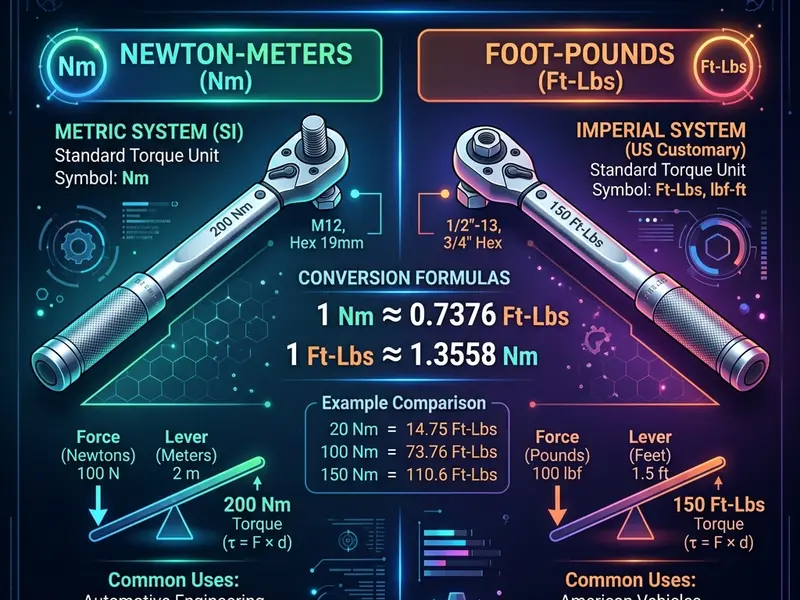
1 Nm = 0.7376 Ft-Lbs. Where This Number Comes From
The conversion factor between Newton-meters and foot-pounds is derived from the underlying relationship between metric and imperial units:
- 1 foot = 0.3048 meters
- 1 pound-force = 4.44822 Newtons
- Multiply: 0.3048 × 4.44822 = 1.3558 (the Nm-per-ft-lb factor)
- Invert: 1 ÷ 1.3558 = 0.7376 (the ft-lbs-per-Nm factor)
The formula: ft-lbs = Nm × 0.7376
That’s it. One number. Memorize 0.7376 and you can convert any torque value from Nm to ft-lbs, anywhere, without a phone or calculator.
The Easy Shortcut: Multiply by 0.74
Don’t want to remember four decimal places? Use 0.74 instead. It’s only off by about 0.3%, a difference so small it’s irrelevant for the vast majority of workshop tasks.
| Method | Multiplier | 100 Nm = | Accuracy |
|---|---|---|---|
| Exact formula | × 0.7376 | 73.76 ft-lbs | 100% |
| Quick shortcut | × 0.74 | 74.00 ft-lbs | 99.7% |
For safety-critical fasteners (head bolts, suspension, brakes), use the full 0.7376. For everything else, 0.74 is perfectly fine.
Step-by-Step: How to Convert Nm to Ft-Lbs by Hand
Here’s the complete process, broken down into simple steps anyone can follow:
Step 1. Write Down Your Nm Value
Find the torque specification in your service manual. Let’s say it reads 100 Nm.
Step 2. Multiply by 0.7376 (or Use the 0.74 Shortcut)
Grab a scrap of paper or do it in your head:
100 × 0.7376 = 73.76
Or using the shortcut:
100 × 0.74 = 74
Step 3. Round to a Practical Decimal
Most torque wrenches can only be set to the nearest whole number or half-number. Round your result:
- 73.76 → 74 ft-lbs ✓
Set your wrench and tighten.
Worked Example: 100 Nm to Ft-Lbs
This is the most commonly searched conversion, so let’s walk through it clearly:
- Start with: 100 Nm
- Multiply: 100 × 0.7376 = 73.76 ft-lbs
- Round: ≈ 74 ft-lbs
- Set your wrench to 74 ft-lbs and tighten until it clicks
Worked Example: 25 Nm (Small Bolts) to Ft-Lbs
Small fasteners like oil drain plugs often spec at 25 Nm:
- Start with: 25 Nm
- Multiply: 25 × 0.7376 = 18.44 ft-lbs
- Round: ≈ 18.5 ft-lbs
- Set your wrench to 18.5 ft-lbs
The Mental Math Trick for Fast Estimates
When you’re under the car and your hands are covered in grease, you need a method that works entirely in your head.
Divide by 1.356 as an Alternative Method
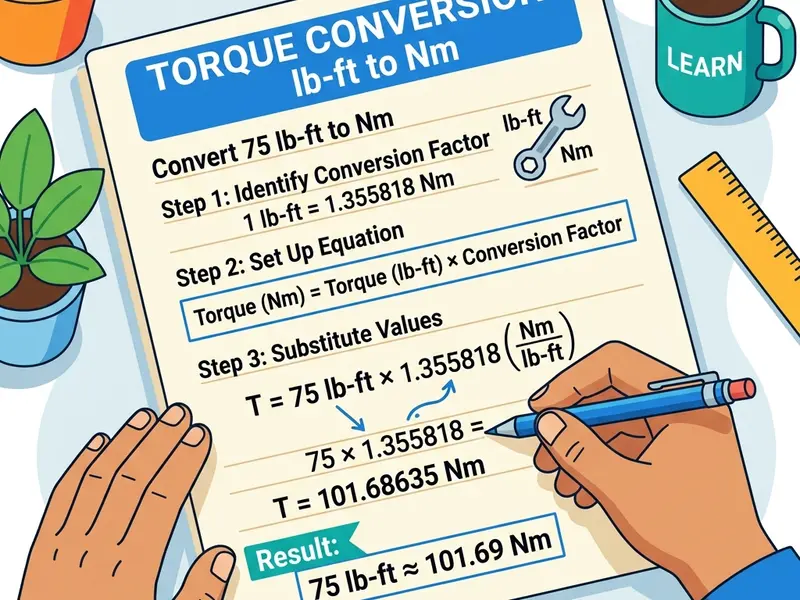
Instead of multiplying by 0.7376, you can divide by 1.356. The math is equivalent:
ft-lbs = Nm ÷ 1.356
Some people find division by a “close to 1.35” number easier to visualize. For example:
- 80 Nm ÷ 1.356 ≈ 59 ft-lbs ✓
- 120 Nm ÷ 1.356 ≈ 88 ft-lbs ✓
How to Use Fractions and Rounding for Field Estimates
Here’s a quick mental trick: take three-quarters (¾) of the Nm value.
- ¾ of 100 = 75 (actual: 73.76), close enough
- ¾ of 80 = 60 (actual: 59.01), spot on
- ¾ of 40 = 30 (actual: 29.50), excellent estimate
This “three-quarters rule” is the fastest method you can do without any tools. It works because 0.75 is very close to the actual factor of 0.7376.
💡 Pro tip: The three-quarters trick always slightly overestimates (by about 1.7%). That means you’ll set your wrench a tiny bit higher than the true value, marginally safer than under-tightening.

Nm to Ft-Lbs Reference Chart (Common Torque Values)
Lug Nuts, Spark Plugs, Cylinder Head Bolts. Real-World Specs
Bookmark this table. It covers the torque specs mechanics encounter most frequently:
| Nm | Ft-Lbs | Common Application |
|---|---|---|
| 10 | 7.4 | Small screws, electronics covers |
| 20 | 14.8 | Spark plugs (small engines) |
| 25 | 18.4 | Oil drain plugs |
| 35 | 25.8 | Valve cover bolts |
| 50 | 36.9 | Brake caliper bracket pins |
| 65 | 47.9 | Intake manifold bolts |
| 80 | 59.0 | Lug nuts (compact cars) |
| 100 | 73.8 | Lug nuts (mid-size sedans) |
| 120 | 88.5 | Wheel bolts (trucks/SUVs) |
| 150 | 110.6 | Suspension control arm bolts |
| 200 | 147.5 | Axle nuts, hub assemblies |
| 250 | 184.4 | Crankshaft pulley bolts |
| 300 | 221.3 | Heavy drivetrain / flywheel bolts |
Printable Quick-Reference Table
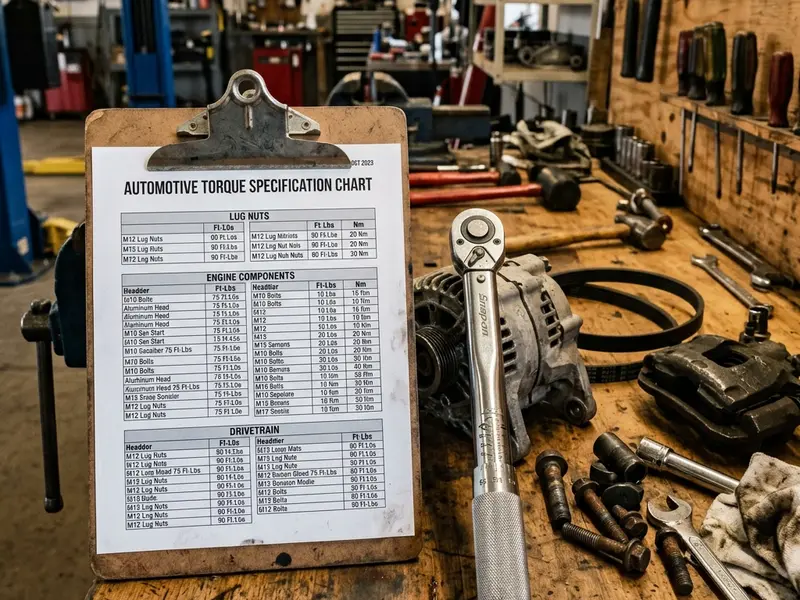
Print the table above and tape it inside your toolbox lid. Having these values at a glance saves time and eliminates conversion errors when you’re in the middle of a job.
💡 Tip: For any value not on this chart, just multiply the Nm by 0.7376, or use our Nm to ft-lbs converter for a precise answer in one click. There is also a printable Nm to ft-lbs torque chart if you would rather tape one inside the toolbox lid.
How to Convert Ft-Lbs Back to Nm (Reverse Conversion)
Multiply Ft-Lbs by 1.3558 to Get Nm
Sometimes you need to go the other direction: you have a spec in ft-lbs but your wrench reads Nm. The reverse formula is just as simple:
Nm = ft-lbs × 1.3558
Reverse Worked Examples
Example 1: 50 ft-lbs → Nm
- Start with: 50 ft-lbs
- Multiply: 50 × 1.3558 = 67.79 Nm
- Set your wrench to 68 Nm
Example 2: 80 ft-lbs → Nm
- Start with: 80 ft-lbs
- Multiply: 80 × 1.3558 = 108.46 Nm
- Set your wrench to 108 Nm
Quick reverse shortcut: multiply ft-lbs by 1.36 for a fast estimate that’s accurate to within 0.3%.
| Direction | Formula | Shortcut |
|---|---|---|
| Nm → Ft-Lbs | × 0.7376 | × 0.74 |
| Ft-Lbs → Nm | × 1.3558 | × 1.36 |
Common Mistakes When Converting Torque by Hand
Even experienced mechanics slip up on these. Here’s what to watch for:
Confusing Nm with N·m (Notation Issues)
You might see torque written as Nm, N·m, N⋅m, or even N-m. They all mean the same thing. Newton-meters. Don’t be thrown off by the notation. The dot, hyphen, or lack thereof is just a formatting choice.
However, never confuse N·m with N/m (Newtons per meter). N/m is a completely different unit (stiffness), not torque.
Rounding Too Aggressively on Critical Fasteners
The difference between 0.7376 and 0.74 is small, about 0.3%. But on a cylinder head bolt that’s specified at 150 Nm, that difference is:
- Exact: 150 × 0.7376 = 110.64 ft-lbs
- Rounded: 150 × 0.74 = 111.00 ft-lbs
A 0.36 ft-lb difference. For a head bolt, that’s fine. But if you round to 0.7 instead of 0.74, the error jumps to 5%, that’s potentially dangerous on safety-critical fasteners.
⚠️ Rule of thumb: Use 0.74 for casual work, 0.7376 for anything on the engine, suspension, or brakes.
Mixing Up Ft-Lbs and In-Lbs
This is the most dangerous conversion mistake. Inch-pounds (in-lbs) are 12× smaller than foot-pounds:
- 1 ft-lb = 12 in-lbs
- If a spec says 60 in-lbs and you set your wrench to 60 ft-lbs, you’ll apply 12 times the intended torque
That’s a guaranteed snapped bolt, stripped thread, or cracked component. Always double-check whether the spec is in ft-lbs or in-lbs before you pick up your wrench.

Frequently Asked Questions
How do I convert Nm to ft-lbs without a calculator?
Multiply the Nm value by 0.7376. For a quicker estimate, multiply by 0.74 instead. For example, 100 Nm × 0.7376 = 73.76 ft-lbs.
What is 100 Nm in ft-lbs?
100 Nm is approximately 73.76 ft-lbs. For a quick mental estimate, 100 × 0.74 = 74 ft-lbs.
Is ft-lb the same as Nm?
No. Ft-lbs and Nm both measure torque, but they use different unit systems. 1 Nm equals 0.7376 ft-lbs. They are not interchangeable without conversion.
How do you convert ft-lbs back to Nm?
Multiply the ft-lbs value by 1.3558. For example, 50 ft-lbs × 1.3558 = 67.79 Nm.
What is the easiest way to remember the Nm to ft-lbs conversion?
Remember 0.74, it’s close enough for most workshop estimates. Multiply any Nm value by 0.74 to get a fast approximation in ft-lbs. Or use the “three-quarters rule”, just take ¾ of the Nm value.
What is 25 Nm in ft-lbs?
25 Nm is approximately 18.44 ft-lbs. This is a common torque spec for oil drain plugs and smaller automotive fasteners.
Why do torque specs use both Nm and ft-lbs?
Because the metric system (Nm) is standard globally while the imperial system (ft-lbs) is still dominant in the United States. Manufacturers publish specs in both units to serve their full market.
Final Takeaway: The One Formula to Remember
If you take only one thing from this guide, make it this:
ft-lbs = Nm × 0.7376
That’s the exact conversion. For quick estimates in the field, round to × 0.74 or just take three-quarters (¾) of the Nm value.
- Nm → ft-lbs: multiply by 0.7376 (or 0.74)
- Ft-lbs → Nm: multiply by 1.3558 (or 1.36)
- Never confuse ft-lbs with in-lbs: they differ by a factor of 12
- Use the exact factor for safety-critical fasteners, engine, suspension, and brakes
If you’re still confused about the difference between these units, read our guide on Nm vs ft-lbs to learn exactly when to use each.